We engineer microfluidic systems to discover molecular recognition tools, translate binding into electrical signals, and investigate fluid dynamics for structural biology. Our work connects aptamer discovery, electronic biosensing, and the physics of droplets and mixing.
Discover. Rapid microfluidic SELEX. Detect. Aptamer-based FET sensors. Understand. Cryo-EM fluid mechanics and micromixing.
01 · Microfluidic Aptamer Discovery
We develop microfluidic platforms to accelerate the discovery of aptamers—short nucleic-acid sequences that bind specific molecular targets. By integrating selection steps on a chip, we aim to reduce sample consumption and simplify iterative enrichment through systematic evolution of ligands by exponential enrichment (SELEX). Our work connects selection with candidate evaluation, supporting affinity probes for protein recognition, therapeutic monitoring, and intracellular analysis.
Approaches
Integrated microfluidic SELEX · Target-specific enrichment · Aptamer candidate evaluation
Representative publications
- Intracellular BAX aptamers · Meng et al., Radiation (2025)
- Cost-effective aptamer evaluation · Talanta (2024)
- Anti-idiotype aptamers · Biosensors and Bioelectronics (2024)
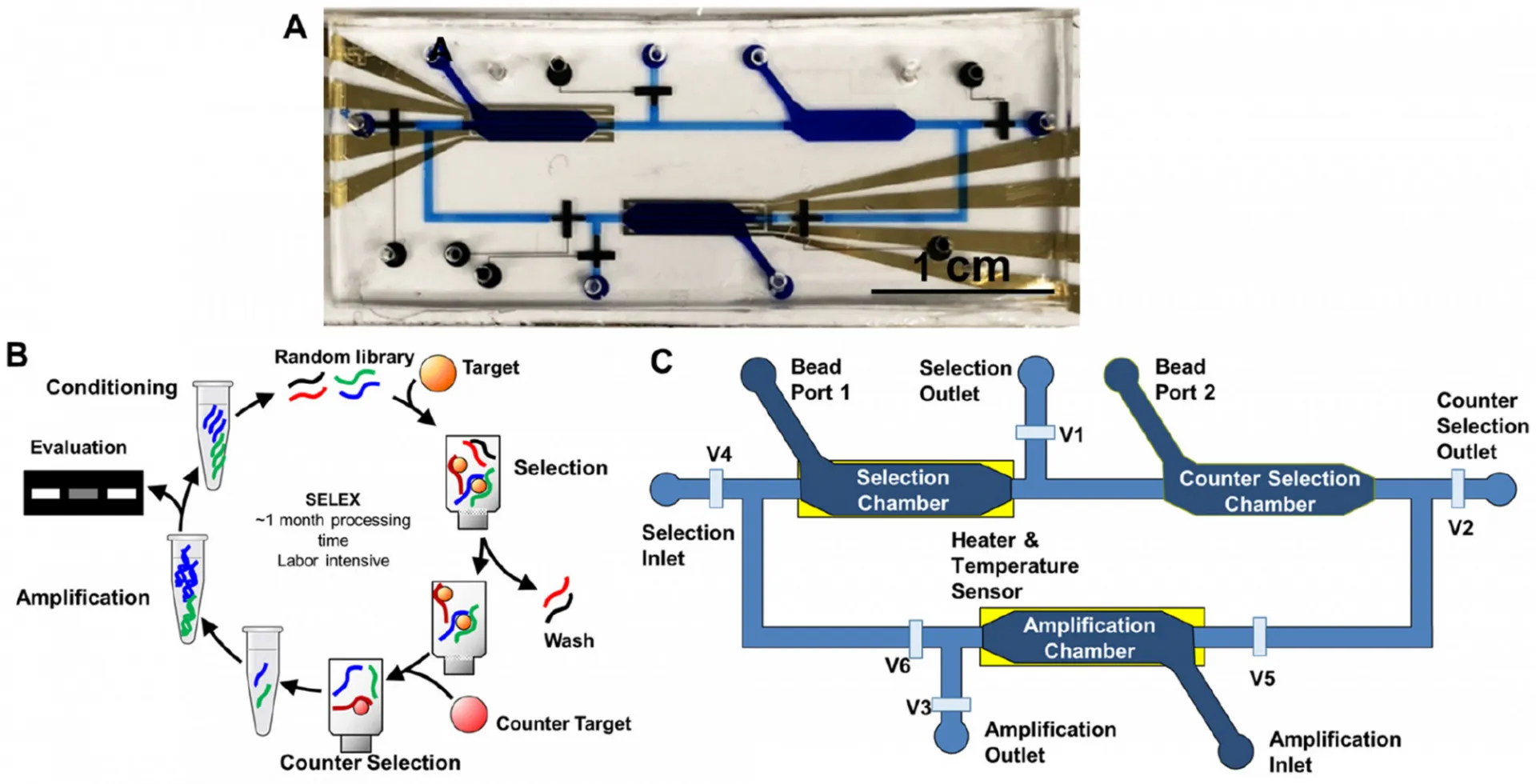
Full-chip microfluidic SELEX platform. Meng et al., Radiation (2025), Figure 1. View figure and article · CC BY 4.0.
02 · Aptamer-Based FET Biosensors
We integrate aptamer recognition with field-effect transistor (FET) sensors to translate molecular binding into electrical signals. By combining target-specific affinity probes with graphene interfaces and controlled surface chemistry, we investigate biomarker detection in biological samples. Our research examines how aptamer attachment and surface passivation influence sensor performance, including measurements in complex media. This direction connects molecular discovery with electronic readout for affinity-based biosensing.
Approaches
Aptamer–FET integration · Graphene surface functionalization · Electrical biomarker detection
Representative publications
- Graphene surface functionalization · Dai et al., Sensors (2026)
- Vasopressin nanosensing · ACS Sensors (2024)
- Metal–organic framework nanobiosensors · ACS Applied Nano Materials (2024)
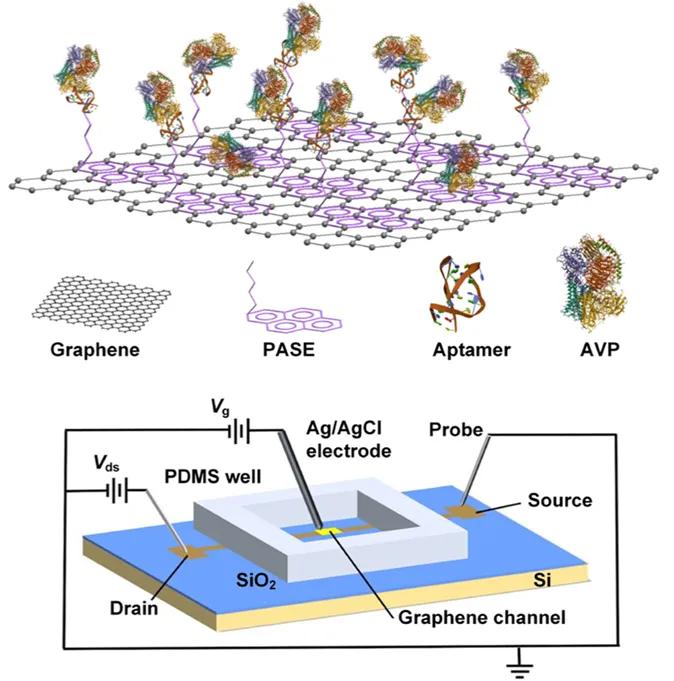
Aptamer-functionalized graphene interface and field-effect transistor device architecture for vasopressin (AVP) sensing.
03 · Cryo-EM Fluid Mechanics & Micromixing
We study the fluid mechanics behind sub-millisecond time-resolved cryo-electron microscopy (cryo-EM). We investigate how micrometer-scale droplets spread on cryo-EM grids to form the thin films needed for vitrification, using high-speed imaging experiments, OpenFOAM simulations, and image analysis of where thin ice forms.
In parallel, we design, simulate, and analyze micromixers that use chaotic advection, investigating fluid transport and mixing at the microscale.
Approaches
High-speed imaging · OpenFOAM simulations · Thin-ice image analysis · Chaotic-advection micromixer design
Related laboratory work
- Freezing Time · Columbia research update (2024)
- Microfluidic technology for cryo-EM sample preparation · Columbia Technology Ventures
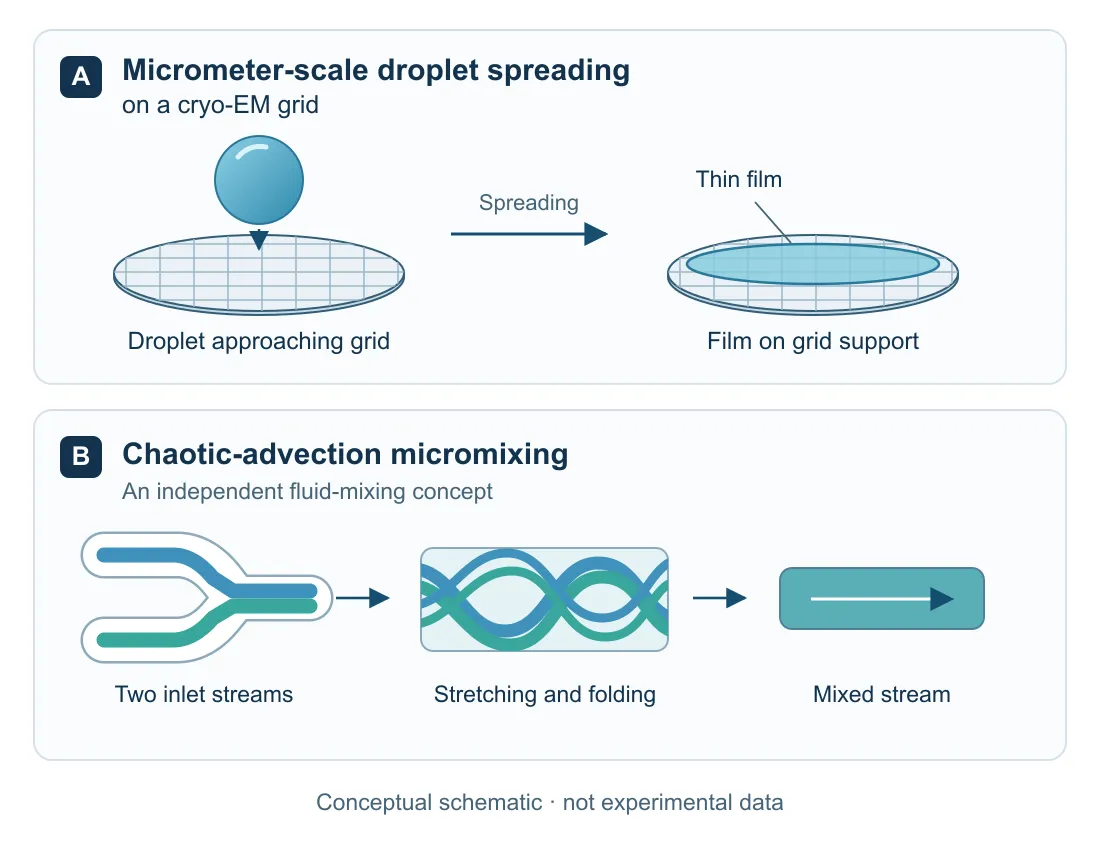
Droplet spreading on a cryo-EM grid and chaotic-advection micromixing are shown as two separate research topics.
Research Archive
Explore the laboratory’s established work in aptameric microfluidics, implantable affinity biosensors, biomolecular characterization, polymer-enabled flow control, and BioMEMS modeling.
Browse earlier research and the complete project index · View all publications